The Character of Wood: Why Knots, Grain, and Variation Are Features, Not Flaws
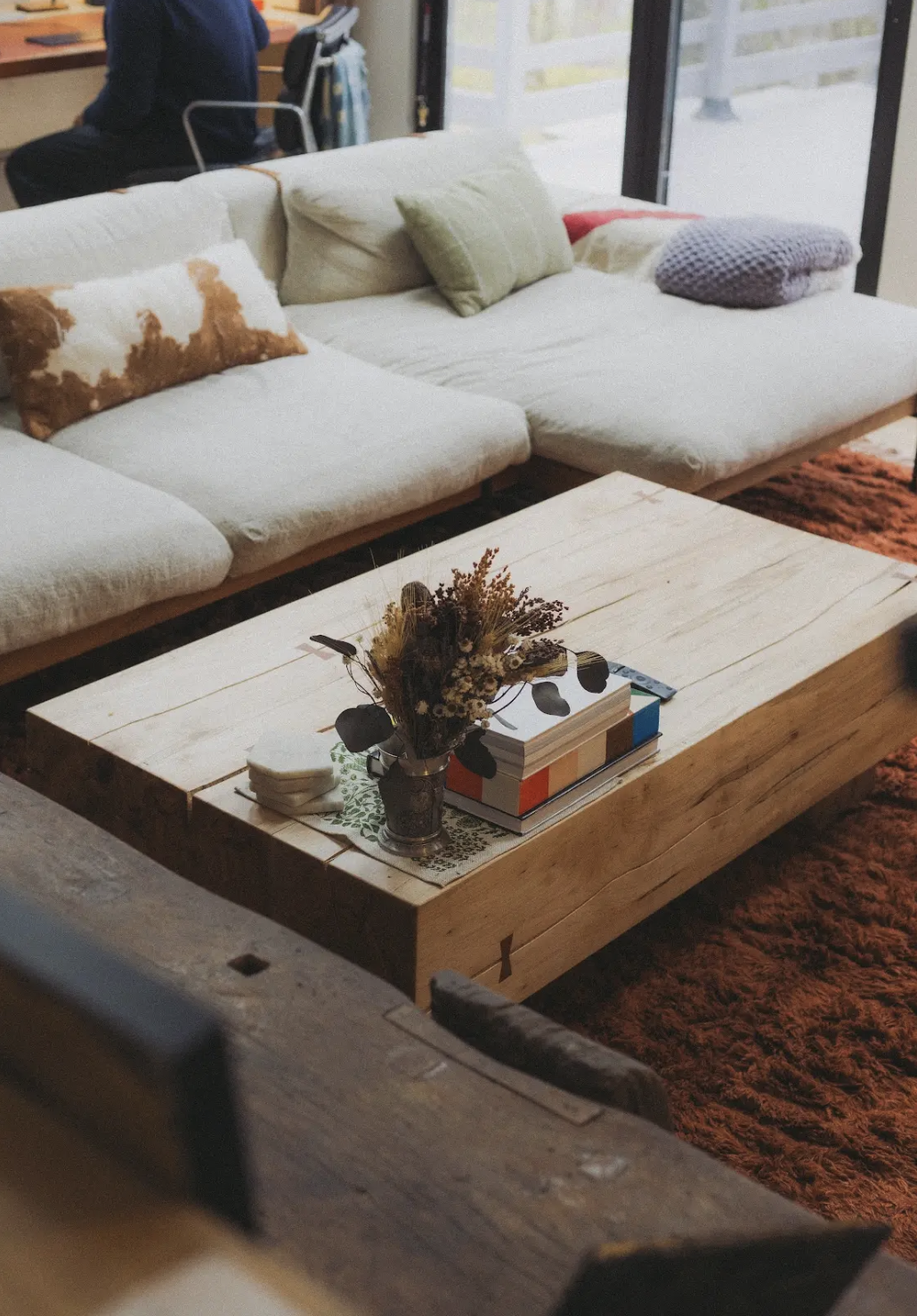
There's a moment that often happens in client conversations we have. We're looking at a slab together, and they point to a knot or a mineral streak or a place where the grain does something unexpected, and they ask: "Is that a problem?"
It's never a problem.
In fact, it's usually the best part of the board.
Where the "Perfect Wood" Idea Comes From
Most people's experience with wood comes from home improvement stores, furniture chains, and big box retailers. The wood in those places has been selected, processed, and finished specifically to remove variation. Every board looks like the next one. The goal is consistency and predictability at scale.
That works fine for what it is. But it trains people to see variation as a defect. And when they encounter real wood, wood that grew in the ground, absorbed decades of sunlight and rain, and developed a personality entirely its own, they sometimes don't know what to make of it.
We think its important to reframe and take the time to talk to our clients about amazing “imperfections” that will make their project one-of-a-kind. Once people understand what they're actually looking at, their whole relationship with the material changes.
What Knots Actually Are
A knot forms where a branch once grew out from the trunk. As the tree added growth rings over the years, that branch junction got incorporated into the wood. What you're left with is a record of how the tree actually lived: where it reached for light, how it responded to its environment, what happened to it over decades of growth.
A tight, well-formed knot in a piece of red oak or walnut isn't a weakness. It's a history. And in most furniture and millwork applications, it's perfectly stable and structurally sound when the wood has been properly dried and the piece has been well designed.
Some of our favorite projects have been built around a particularly striking knot, a slab where the grain swirls around a dark center like a fingerprint. You can't replicate that in a factory. You can't order it from a catalog. It exists once, in one piece of wood, and then it becomes part of someone's home.
What Grain Variation Tells You
Grain is the pattern created by the tree's growth rings and the way the log was cut. Straight grain, cathedral grain, figured grain, ray fleck, each one is a result of how the tree grew and how the saw moved through it.
Wide plank boards cut from older, slower-growing trees show tighter, more consistent rings. Boards cut from faster-growing trees show wider, more dramatic patterns. Neither is better. They're different, and that difference is part of what makes selecting the right material for the right project genuinely interesting work.
When we mill our own logs here in the Hudson Valley, we pay close attention to how we break down each piece. The way a log is sawn dramatically changes the grain pattern that appears on the face of the board. Quarter sawn white oak, for example, reveals a distinctive ray fleck pattern that you simply cannot get any other way. It's one of the reasons it's become one of the most sought-after looks in high-end cabinetry and furniture.
Mineral Streaks, Color Variation, and Live Edge
Beyond knots and grain, real wood comes with a full range of natural variation that mass production tries to eliminate.
Mineral streaks are dark lines or patches caused by minerals in the soil the tree absorbed over its lifetime. In walnut they can appear as dark grey or olive-toned streaks running through the board. In maple they show up as dramatic dark figures that furniture makers call "character grade,” a term that says everything about how you should think about them.
Color variation within a single species is also completely natural. Sapwood, the lighter outer portion of the log, often appears alongside the darker heartwood in a single slab. Some people ask us to remove it. Others specifically request it. The contrast between the two can be stunning, and it tells the story of how the tree was structured from the outside in.
Live edge, of course, is the ultimate expression of this philosophy. Rather than removing the natural edge of the tree and squaring everything off, we preserve it. The curves, the irregularities, the places where the bark once met the wood, all of it stays. The result is a piece that couldn't have been designed. It could only have been grown.
Why It Matters for Your Project
When you commission a piece of custom furniture or millwork from Rescue Slabs, you're not ordering a part. You're working with a material that has a story, and part of our job is helping you find the piece of that story that belongs in your home.
We talk to every client about what they're drawn to and what makes them uncomfortable. Some people love the drama of a heavily figured slab. Others prefer the quieter beauty of clean, consistent grain. Both are valid. Both are available to us. But the conversation always starts with an honest look at the material and an understanding that what you're seeing isn't imperfection, it's identity.
Start a Conversation
If you're considering a custom dining table, cabinetry, wide plank flooring, or any other woodwork project and you're not sure what species or character level is right for you, come by our showroom in Middletown, NY. We'll pull some slabs and talk through it.
That's always the best place to start.
Rescue Slabs is a custom woodwork and millwork shop in Middletown, NY, producing custom furniture, architectural millwork, and wide plank flooring from locally sourced Hudson Valley timber, milled and crafted in-house. To start a project, reach us at rescueslabs@gmail.com or (646) 306-9229.